Showing posts with label photos. Show all posts

03 December 2011

What to do with those old colour slides?


I have literally thousands of colour slides – probably 8,000-9,000 of them, from times which range from when my father bought his little Voigtlander Vito B in about 1955 until I took my last colour transparencies in the 1990s.

The question is what to do with them all in the time poor digital age.  How often would one get out the projector and set up the screen, manually load the slides into the projector’s magazine, and settle in for a slide evening?  Answer: effectively never.

Clearly the answer is to harness the technologies of the digital age and digitise the lot.  To that end, in about 2001 I purchased a transparency adapter for my HP flatbed scanner, and produced some acceptable digital photos from some of my favourite slides.  I was pretty happy with this at the time, but it is a process that has couple of downsides It is very labour intensive, and as the scanner is focusing through the screen onto a transparency that is sitting above the glass, its focus will tend to be thrown off somewhat by backscatter from the surface of the glass.  Acceptable resolution is achievable but high resolution is not, and the process struggles to produce a file that will allow a print larger than 15cm x 10 cm.

Also, good old Hewlett Packard decided not to release drivers for that particular scanner for operating systems post Windows XP.  I found some third party software that would allow me to continue to use the scanner but it will only scan at a resolution of 1200 x 1200 dpi, and while it offers a range of post-scan processing options it does not permit the simple option of scanning the slide as is and not mucking about with it.

So after a bit of homework on the I web imported from the United States a specialised slide scanner, a Pacific Image Electronics PowerSlide 5000, which as its name suggests scans at a magnificent 5000 x 5000 dpi. This appears to be a clone of a German original made by Braun; I could not find on the web any sign of an Australian retailer for either the Braun machine or the US equivalent.

The machine comes bundled with Adobe Photoshop Elements 8.0, and there are options which enable files to be sent to that software for processing, but as I have a copy of Photoshop CS3 I prefer to take the scans as JPEG files exactly as they come off the scanner, and make any tweaks I want to as a separate step.  Any slide with the right exposure will be acceptable without further processing, but the wonderful thing about digital technology is that those very important under- or over-exposed slides of family occasions or long departed friends can be very considerably enhanced and seen as intended.

The slides are fed into the scanner from a standard slide magazine which holds fifty slides.  They can be scanned at any resolution up to 5000 dpi, to either TIFF or JPEG files, using 8-bit or 16-bit colour, with two or three quality options.  After a bit of experimentation I am systematically scanning the whole collection at highest quality in 16-bit colour at full resolution.  This means I am not having to make decisions about which treatment to apply to which slides, and I also have the maximum opportunity subsequently to crop a slide heavily and still have a good quality photo of the reduced field of view, or a detail of the photo.

This approach is not for the faint hearted because it is very heavy on storage; such high quality scans produce files in the range 13-15MB, which means that you are looking at about 500MB to scan one 36-exposure roll of film. 

Scanning at this quality is a pretty slow process – it takes about 4-5 minutes per slide, but as they feed automatically into the scanner it is possible to load up a batch and then go and do something else – as long as that something else is not a process on your computer that requires more than a modicum of RAM, as the process is pretty heavy on memory.

There is a downside to everything of course, and the downside of scanning at such high resolution is that your scans come up with a magnificent high resolution image of every biological colony that has made a home for itself on your slide collection over the course of half a century.  That is where Photoshop CS3’s spot healing tool comes in – it really does a great job of cleaning scratches, smears and the spots of bio-debris from the image.

This of course is only half the story – after putting all this effort in you have gone from having boxes of slides that you never get around to looking at to having hundreds of Gigabytes of files on a hard drive somewhere.

I have two solutions for this, to get me to the point where I actually see some of these precious images.   The first is that I keep as many of them as I can in a master folder on the hard drive of the laptop which I carry backwards and forwards between home and the office.  I point the screensaver to that master folder, so that every time the screensaver cuts in I get a random display of all of the photos in the folder.  As I use an external monitor at both locations, I get to see a selection of my slides in a high quality format quite regularly.

The second (more systematic viewing) solution is that I recently purchased an Apple TV unit for about $139. This plugs into my TV via an HDMI cable, so I can view any chosen subfolder of the master folder simply by firing up iTunes and transmitting the images to the high definition TV screen over the home wi-fi system.  Works a treat.

Expect more pictures on Aussie Observer.

26 April 2011

A brief trip to the Southern Highlands


Last week I took the opportunity of a trip to Sydney to accept an invitation from my friend Harry Pidgeon to spend a couple of days at his home at Bundanoon in the Southern Highlands of New South Wales.

One of the highlights of a wonderful couple of days in a beautiful part of the world was a visit to the fortieth annual meeting of the Southern Highlands Carriage Club, which brings horse-drawn carriage enthusiasts from all over NSW. On the day we visited the cone racing was on – time trials through a series of witch’s hats with balls mounted on them – cause one of the balls to fall and you lose points.

We passed the time of day briefly with the lady in the first photo, who told us she was from Parkes. “Parkes?” I said. “Would you happen to know a man named Terry Hunter?” “Of course”, she replied. Terry Hunter was a contemporary of mine in Wright College at the University of New England, who has spent the last thirty years working in the family real estate business G. Hunter & Company Pty Limited. Small world.


The following day Harry took me, a friend of his and a couple of our other former school classmates to the croquet lawns at Exeter, to receive instruction in the ostensibly sedate but quietly vicious game of croquet. That proved to be great fun, and we continued until bad light stopped play. From left to right in the photo below are former classmates Harry Pidgeon, Hugh King and Philip Bailey.


19 September 2010

The Class of 1960, fifty years on


The weekend of Friday-Sunday 10-12 September was Old Boys’ Weekend at The Armidale School (TAS) and for the Class of 1960 it was of course the fiftieth anniversary of the year we sat our New South Wales Leaving Certificate, and we decided to make it a big one.

After years in the grip of drought, Armidale has had some rain, and the School looked a treat:


The weather throughout the weekend was brilliant – not a cloud in the sky, calm, mild – 15.4 deg C max on Saturday, 18 on Sunday.

A group of us had decided that a fine way to commemorate the year would be to commission a painting by classmate Harry Pidgeon, and commemorate also our late classmate Alex Buzo, for which purpose we sought the participation of Alex’s daughter Emma who had kicked off Old Boys’ Weekend 2009 with her revival of Alex’s first play, Norm and Ahmed (see Norm and Ahmed go to Armidale).

We asked Harry to paint something that captured the feeling of an aspect of the New England landscape, but left him to decide how to give effect to that.  The result is stunning, Rising Moonbi, a painting in acrylic of the moon rising over a granite tor, so characteristic of the Moonbi range which rises so steeply to the tablelands from the village of Moonbi north of Tamworth, and of the tablelands country itself.  In early maps the village and the mountain range are labelled Moonboy, apparently a reference to the fact that the ascent of the first part of the range was so steep that the teamsters had to yoke the bullocks or horses of several teams to one wagon and haul them to the top one by one, an operation best performed at night, but for which it was necessary to have a “moon boy” walking ahead showing the way and scouting for obstacles. The painting represents also the brightly coloured birds which suddenly appear out of the rather dull coloured landscape.


On the Friday afternoon I went with the 1960 Senior Prefect, Philip Bailey, and with Harry Pidgeon, to the Hoskins Arts Centre to do the last minute setting up of the painting for the presentation, to talk to Headmaster Murray Guest about where it might best be displayed in the long term, and to talk to Pat Bradley, the School’s Business Manager, about how it would best be lit at the presentation function:


Pat arranged for it to be lit from a gallery above, with stunning effect; the painting glowed, but it was not evident where the light was coming from, or indeed that it was lit at all.

Needless to say, we paused for a photo-op; from left to right your correspondent, the artist, and Philip Bailey:


No photos by me from the presentation ceremony – being the MC for the occasion I was not in a good position to wield the camera, and I will post later any good photos that come to hand from the occasion.  There were two presentations: Harry’s painting, unveiled by former master Jim Graham (see below), who fittingly had started his 43 year career at TAS in 1956, the year that the bulk of the Class of 1960 had started secondary school.

The second presentation was a presentation by Emma of a photo of Alex from the 1970s, framed with a bio that Emma herself had written. Thanks to Visual Arts master James White for the photo.

I could not help concluding the presentations by observing that the Class of 1960’s most important gift to the School was Emma herself, as she will be taking up duty at the School from the start of next year as drama teacher and manager of the Hoskins Centre. For more on Alex, Emma, and the company Emma founded to produce, promote and perpetuate the work of her father, see The Alex Buzo Company.

On Saturday morning we had a casual brunch in Big School, which had been the centre of the School’s activities in the 1950s – assembly hall, place of Saturday night films, roll-call, exam room, and place of Saturday morning detention:


Needless to say we had invited Jim Graham, and a photo or two was taken:


Before we left we set up Harry’s painting there for the rest of the day, to be on display for the many visitors passing through:


We then went off for a tour of the School’s new trade training centre:


which is also a community sports facility:


After that we went to the barbeque on Back Field (Hoskins Centre in the background):


and watched the First XV play the Old Boys:


As none of us made the cut for the Old Boys’ team we watched from the sidelines:


 The Old Boys’ dinner was a treat, with the nice touch that the boys who handed around the canapés were wearing the Norfolk jackets which we were obliged to wear night and day, summer and winter. The Norfolk jacket did not survive the 1960s as the basis of the uniform.

At the dinner, Paul Griffiths launched A Song to Sing-O, Jim Graham’s memoir of 43 years’ involvement with musical drama at TAS (to acquire your copy see below):


Jim responded and delivered an amusing address about the hazards and delights of attending decadal anniversary gatherings of old boys:


After that, a Gilbert and Sullivan sing-along organised by Philip Bailey, with the willing participation of some of the current pupils, as well as girls from NEGS and PLC (a refreshing development, we didn’t see much of them in our day) and some stars from yesteryear, of which more in subsequent posts:


following which we retired to Lower Maxwell for coffee:


On Sunday morning there was chapel for those who were inclined either by conviction or nostalgia; girls from PLC & NEGS joined the choir:


followed by the annual Passing Out Parade of the cadet unit (participation in which was a compulsory activity in our time):


following which Richard and Lynne Bird turned on lunch for those who were able to attend, on the distinctly provençale terrace of their lovely home at the foot of the Devil’s Pinch a few miles north of Armidale:


where there is a granite tor just across the road:


Needless to say, before going our separate ways, we paused for a final photo:


And a good time was had by all.   Our special thanks to Cressida Mort, Donna Jackson and Shona Eichorn, who did so much on the spot, both beforehand and throughout the weekend, to meet our incessant demands and make the whole weekend run so smoothly.

And just for the record, here we are, the Class of 1960 as photographed half a century ago:

 
Note:
To acquire a copy of A Song to Sing-O, please get in touch with the School’s Director of Development, Cressida Mort (cmort@as.edu.au). If you email Cressida, she will send you the book, and you can either send a cheque or ring the School and pay by credit card. The price is $45 including postage and handling.

07 September 2010

Anzac Day 1967


In 1967 the Department of Defence sent me to do a course at the Australian Atomic Energy Commission, Lucas Heights.

We took a flat at Elizabeth Bay, and on Anzac Day wandered up to Elizabeth Street to watch the march – mainly World War II veterans, including Polish veterans and our own Z-Specials (special forces), and a few veterans of World War I.

See the low-rise buildings of 1960s Sydney.  See the sun drenched streets.


04 September 2010

Tony Windsor’s gone to Tamworth


The (very) Independent Member for New England has gone home to Tamworth to ponder the decision he should make about who should have the opportunity to form the next government.

I do not envy him the decision he has to make, but I know that it will be a conscientious one and, whichever way it goes, I expect that he will receive strong support from the local communities.

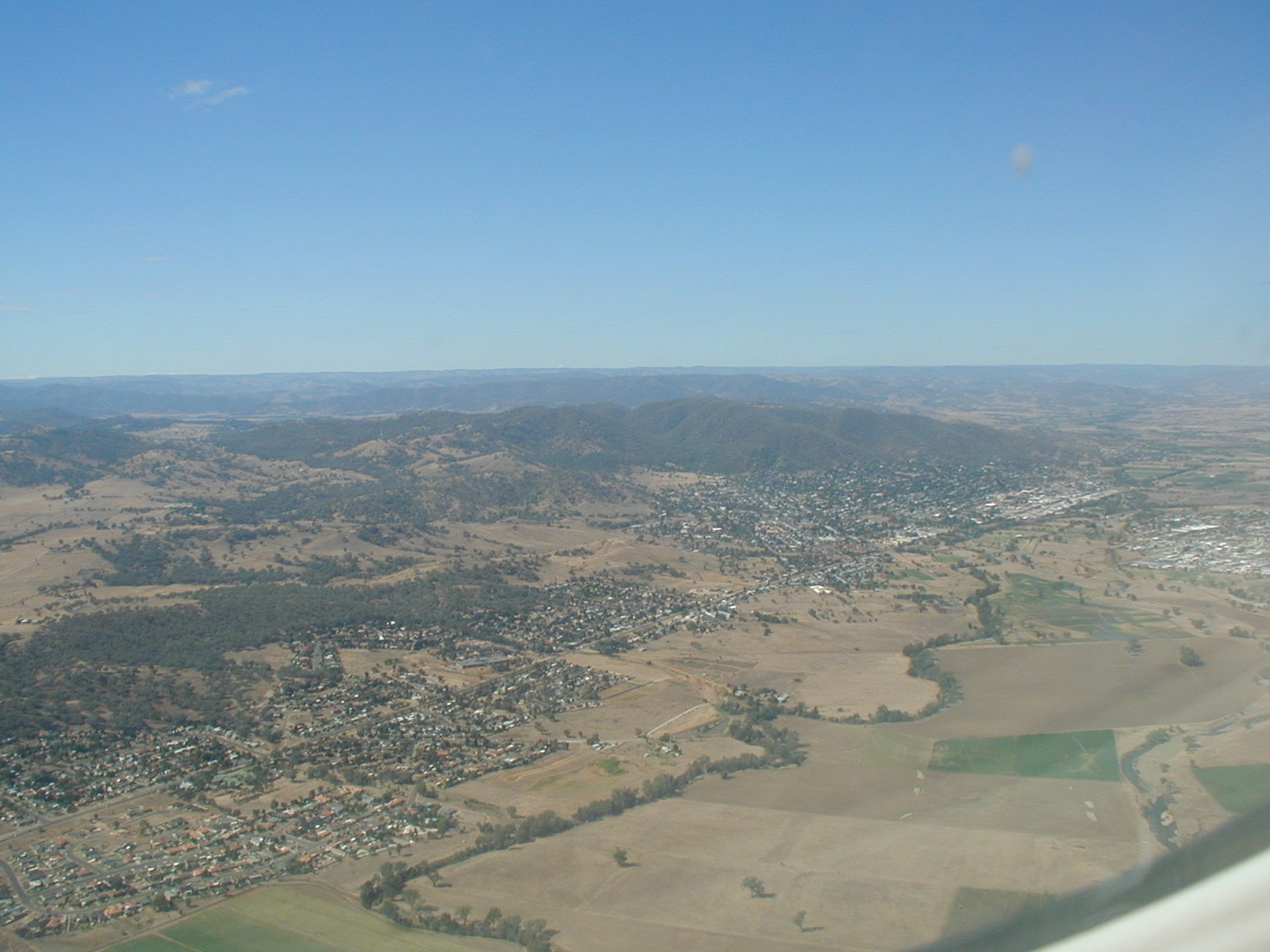
To give a sense of the place, here are a few photos taken from the window of a Qantas Dash-8 as we were coming in to land on the way to Armidale in 2005, when the whole New England region was in the grip of a protracted drought.

Things are better up there now, although the Bundarra – just west of Armidale – Exceptional Circumstances (EC) district was still drought declared as of 29 June 2010.